
Bodega Chacra

Vineyard Profile


Share |

About This Vineyard

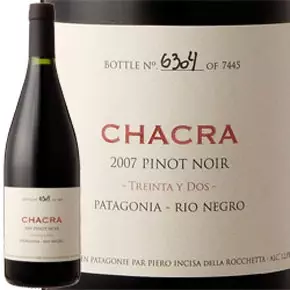
Bodega Chacra is situated in northern Patagonia, the same distance from the Andes Mountains and the Atlantic Ocean. The region has a dry and arid climate and is sheltered by the natural barrier created by the surrounding desert. The air is crystal clear, without pollution, and the sun shines with dazzling intensity. The climate in the region is very consistent, each season marked precisely, which means that vintages can be relied on for their consistent quality. Piero Incisa della Rocchetta first purchased the land for Bodega Chacra in 2004, and subsequently added to it over the years. He comes from a family of winemakers well known in the region. The vineyard, which was abandoned when he first purchased it, has thick, pure, gnarled Pinot Noir vines, planted over seventy years ago. The vines produce tiny bunches of small, concentrated berries which are harvested by hand. When fermentation is complete, the wine is transferred into barriques by gravity, without pressing or filtering. Bottling is done without fining or filtration. The idea is for the oak, the fruit and the nuances of the soil to blend perfectly so that the terroir is expressed to its fullest. Steve Tanzer made note of this distinctiveness during a tasting of the Wines of Argentina where he noted that Chacra Treinta y Dos contains deep, musky aromas of black cherry, licorice, violet, spices and underbrush. And that it is firm and minerally in the mouth, with very primary, energetic flavors of dark fruits and spices. Treinta y Dos finishes with solid but suave tannins and excellent tangy length and lift.

Winter 2007/08 arrived late, in mid June instead of the end of May. It was a shortwinter, but very pronounced, cold and dry with not one drop of rain.Spring was warm, without wind, this favored a good early flowering. Still no rain butwe were plagued with serious frosts. The early frosts were in October, three of themquite strong and then the a coups de gracea arrived very late in November, the first the11th and the second the 14th. The temperatures dropped at 5 below zero. This left theValley badly damaged. Between the province of Neuquen and ours, the Rio-Negro,the damage was estimated at 50%. Luckily our old vines were not hit.Summer began in January with strong winds, hot days and cold nights. ThePatagonian winds tend to dry up a lot but at the same time give us cold nights as theskies are absolutely clear. Still no rain which gave us berries with very thick skins,which means big polyphenols or tannins and very ripe. One can characterize the yearas very hot and dry but with good fruit and acidity because of the thermal amplitude.We began to harvest Barda the 13th of March 2008, the fruit comes partly from ourvineyard in MainquAC and some from a separate block which we have leased for thenext 25 years, this long lease was done with the intention of having full managementon the vineyard, it also gives us the ability to farm it in an organic and biodynamicmanner. Grapes were in optimal condition with small natural yields (40 Hl / Hectare).We picked early in the morning and brought to the winery where we placed them in acool room and consequently de-stemmed by hand. Barda like Chacra a Treinta y Dosa and MainquAC is 100% hand de-stemmed.
here!!!

Smooth with dusty berry, plum, caramel and spice aromas and flavors, this Pinot Noir culminates in a composed and satisfying finish.
here!!!

Smooth with dusty berry, plum, caramel and spice aromas and flavors, this Pinot Noir culminates in a composed and satisfying finish.
here!!!


No video available for this vineyard

Address:
City:
Postcode:
State:
Country:
Phone:
Email:


Patagonia
Argentina